Book matched, Vein-Matched or Naturally Sequenced? How Exceptional Stone Should Actually Be Laid
Posted on by The Quarry
A stone cutter in the Apuan Alps makes a decision that most people who eventually live with that stone may never think about. Before the block is sliced, before the slabs are numbered, before anything leaves Italy, he decides which way the blade should travel through the vein.
That one decision can change how the stone feels in a space, whether the surface comes together as a composition or simply looks like separate pieces placed next to each other.
The Book match
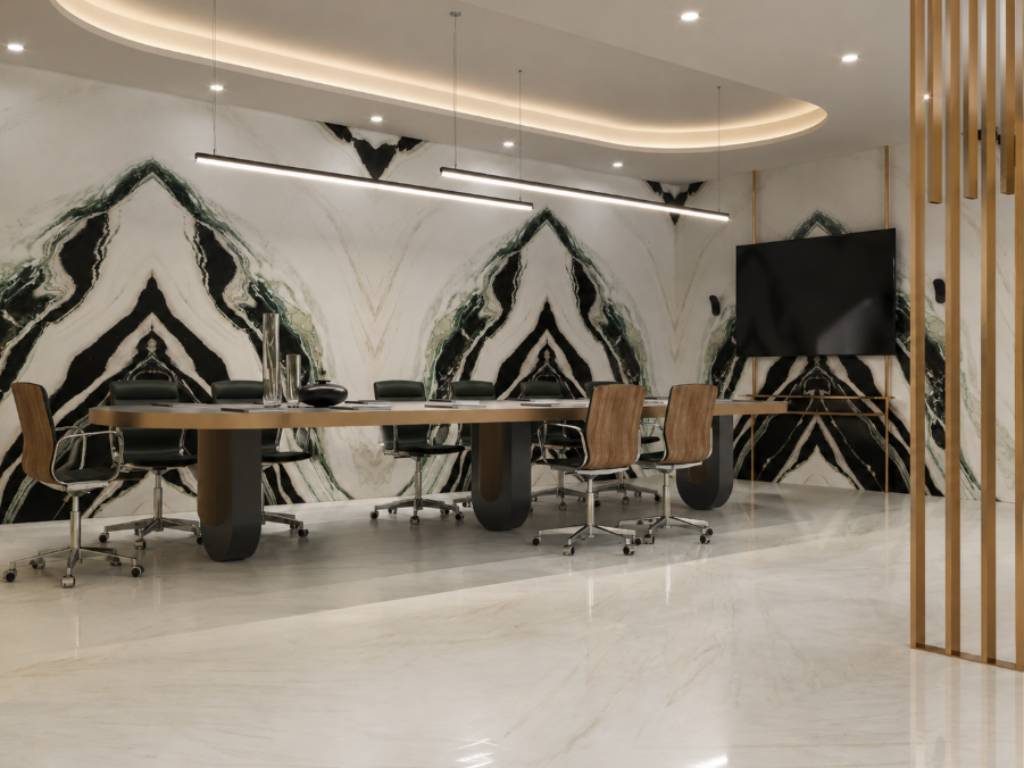
Think of a book lying flat, with the spine in the centre, and then being opened. The left page mirrors the right. Whatever appears on one side is reflected on the other, creating a natural sense of balance and symmetry.
That is essentially what a book match does with stone. When the stone is cut across its veining, or two slabs are joined across their veining, the pattern on one slab meets its reflection at the joint. But the final effect depends completely on what the mountain has given the stone in the first place.
Take Louise Blue, a warm amber quartzite with delicate blue running through its body. When two slabs are opened at the centre, the blue veining finds its reflection and creates a quiet diamond along the axis, surrounded by the warmth of the amber stone. The effect feels almost like a landscape captured in the stone.
Then there is Dalmata, a white marble with bold black inclusions. With four slabs opened in both directions, the black mass comes together to form a strong architectural diamond at the centre. Nothing has been added to the stone. It is simply the natural pattern being revealed in the right way.
This is why a book matched set is never about one slab on its own. It is about how the slabs come together. At The Quarry, every pair is inspected standing face to face before a selection is confirmed.
Book matched sets are processed at the facility in Verona using 20mm precision cutting with alpine water. Each slab is numbered and matched at block level, so the relationship between the slabs is established before the stone reaches residences across India.
The Vein Match
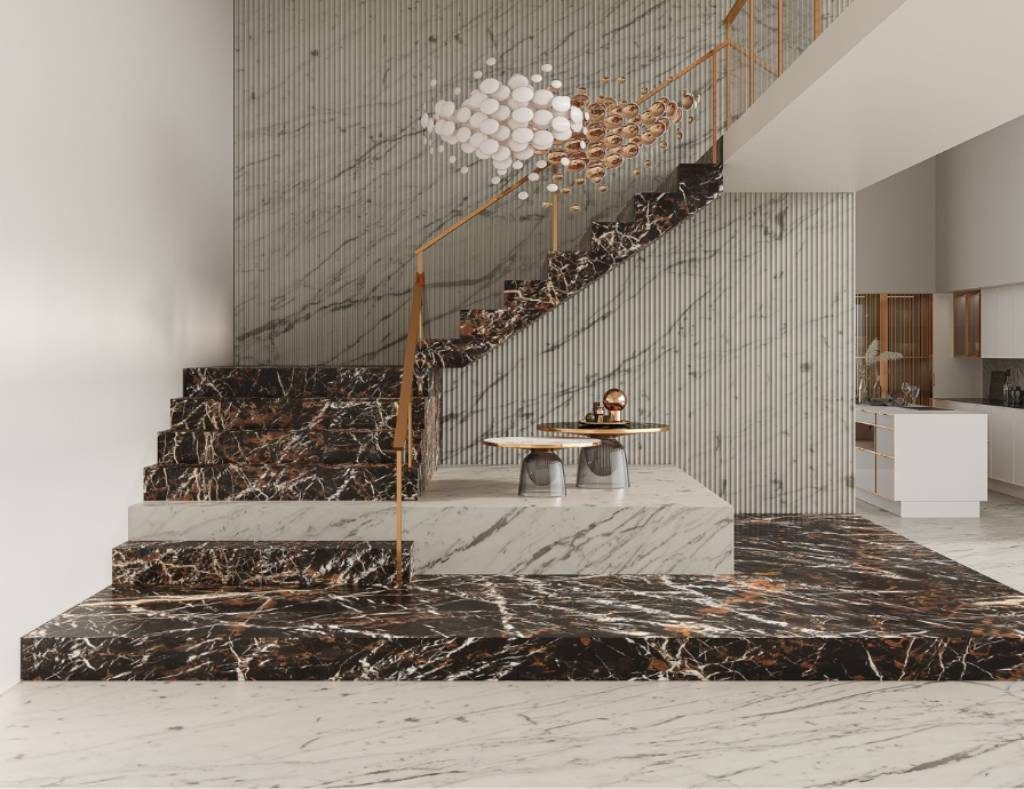
Not every surface needs a mirror. Sometimes, the stone looks better when its movement simply continues.
In a vein match, sequential slabs from the same block are positioned so that their veining travels in the same direction across each joint. There are no reflection and no central axis. The pattern simply continues from one slab to the next, making the individual cuts less noticeable.
Carrara marble is a good example. Imagine two slabs placed side by side in sequence, with the grey veining running diagonally across the first slab, crossing the joint and continuing across the second from exactly where it left off.
Across a full wall, this creates a very quiet but strong effect. The individual slabs start to disappear, and what you notice instead is the continuous movement of the stone. It can make the wall feel as though it was always one surface.
The important part is getting the orientation right. It needs to be checked under the actual light conditions of the space before anything is fixed. The way light falls on the mineral crystals and veins can change how the stone reads, and that is not something that can easily be changed once the stone has been installed.
The Natural Sequence
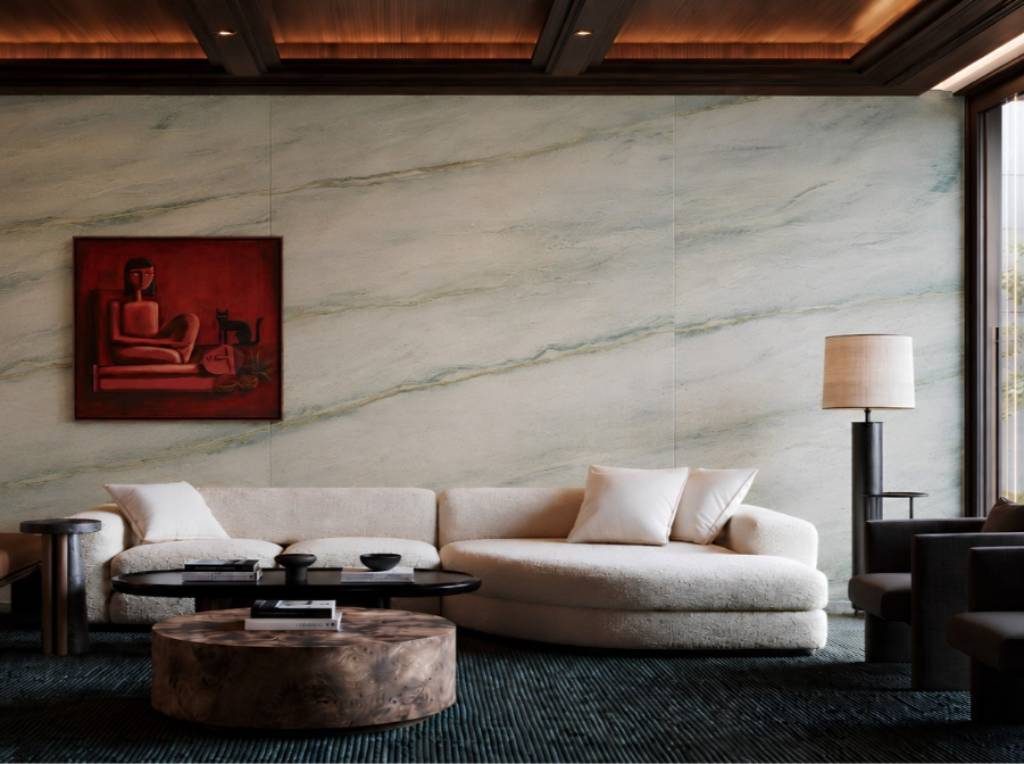
The third approach is the simplest. It does not try to change the stone or create a particular pattern. It simply follows what the block naturally gives you.
The slabs are laid in the order in which they were cut from the block, preserving the geological sequence. The tone may shift slightly from one slab to the next. The veining may become wider, narrower, stronger or softer as the block moves through its natural layers.
Nothing is arranged to create a particular figure. You are simply seeing the stone as it came from that depth, in that quarry.
This works particularly well in spaces where restraint is the luxury. A long corridor clad in Statuario, a series of bathroom walls in a private residence, or a living room where the stone is meant to add warmth before it becomes a pattern.
Here, the material becomes part of the atmosphere rather than the main statement.
At The Quarry, every bundle carries its block reference and slab number. Our 80-20 standard is applied at the curation stage, at the quarry bench itself, so that only material with consistent and documentable character enters our collection.
The stone is then processed in Verona and delivered to the site in the sequence it was selected to be seen.
Laying It Right
Before selecting a slab, the surface needs to be planned on paper. How many slabs will fit? Where will the joints fall? Will they align with a door, column or another detail in the space?
These decisions can change how the stone works in the room. The Quarry Projects team works with architects and designers from the selection stage to ensure the sequence chosen at the Gallery is carried through correctly on site.
Bring your drawings and slab dimensions to the Gallery. Every surface begins with a sequence, and knowing the right one is where we start.
FAQs
The decision is made before the slabs are selected, so the layout can be worked out in advance.
Yes, The Quarry Projects team works with architects and designers from the selection stage through installation, so the sequence selected at the Gallery is followed on site.
No. There may be some change in the tone and veining from one slab to another. That is simply the natural variation within the block.
A book match can be done with two slabs, opened from the centre. Four slabs can be used when a larger composition or central figure is required.
In a book match, the veining mirrors itself across the joint. In a vein match, the slabs follow in the same direction, so the vein continues from one slab to the next.