Bookmatched Marble: Creating Striking Symmetry in Luxury Interiors
Posted on by The Quarry
A single marble slab can hold remarkable movement, but placing two adjoining slabs in mirror alignment changes the way the stone is read. The veins open out from a central line, creating symmetry that feels architectural and individual to that block of stone.
This is why bookmatched marble has become a defining feature in luxury homes. For interiors designed to flaunt marbles as a statement feature, bookmatching offers a way to make the stone itself the focal point. It can shape a living room wall, bathroom backdrop or entrance without relying on added ornament. This guide explains how the pattern is created, where it works best and what to consider while selecting and installing the slabs.
When comparing marble vs tiles, the distinction extends beyond appearance. Natural marble brings variation, depth and continuous veining that cannot be replicated in the same way across individual tiles, making it particularly suited to statement applications such as bookmatched walls.
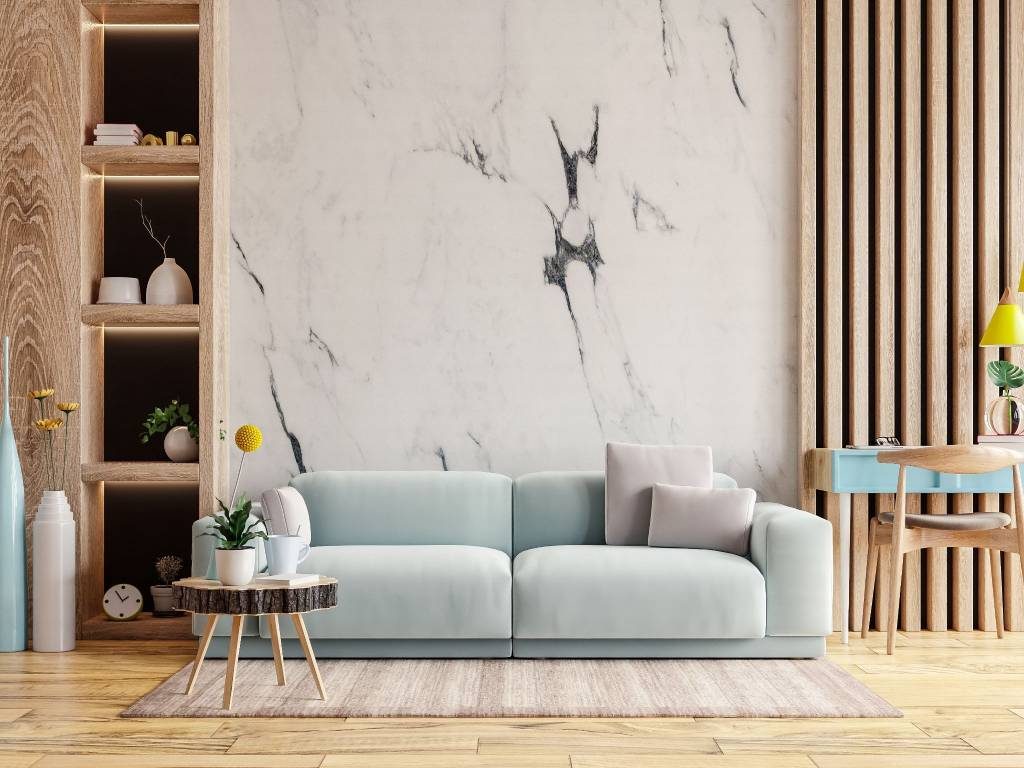
Understanding the Art of Bookmatched Marble
Bookmatching is a layout technique in which consecutive slabs from the same stone block are opened beside one another like the pages of a book. One slab reflects the veining of the other, producing a central composition that may resemble wings, waves or an abstract inkblot.
The effect depends on careful cutting, sequencing and placement. A successful bookmatch marble wall should feel continuous across the joint, with the veins meeting cleanly and the strongest movement positioned where it can be appreciated at full scale. Since the pattern comes from natural stone, every installation remains unique.
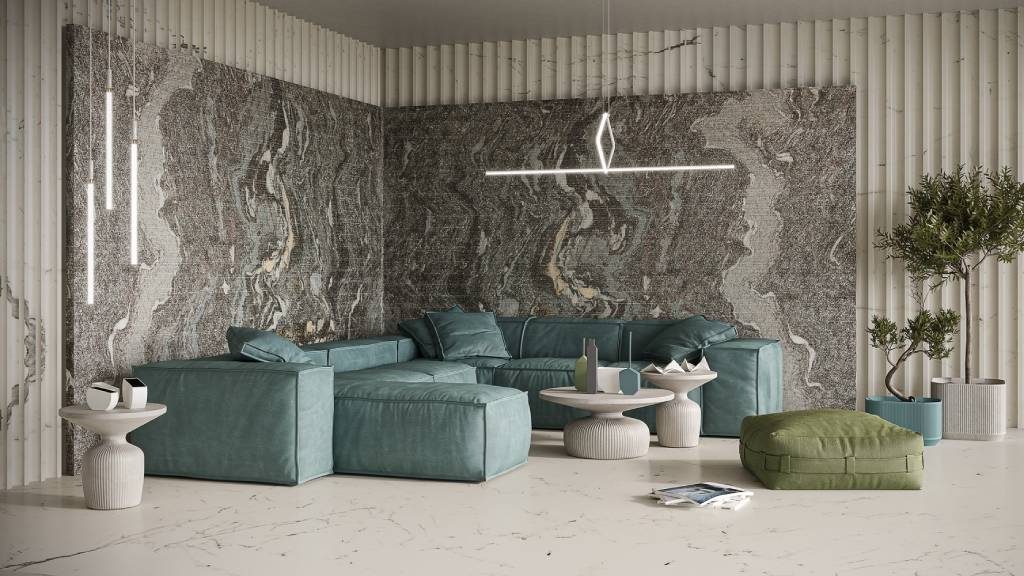
What Makes Bookmatched Marble a Statement Design Feature
Designers often use bookmatched marble where a room needs one visually commanding surface. Its impact comes from the stone itself, as the scale, colour shifts and natural lines determine the final composition. The result is the kind of dramatic stonework often associated with celebrity marbles and high-profile luxury interiors.
Key characteristics include:
- Symmetry that gives irregular natural veining a clear visual order.
- Large-format impact across full-width or double-height walls.
- A central seam that becomes part of the design rather than something to conceal.
- One-of-a-kind patterning, because no two adjoining slab pairs are identical.
- Strong interaction with light in polished as well as honed finishes.
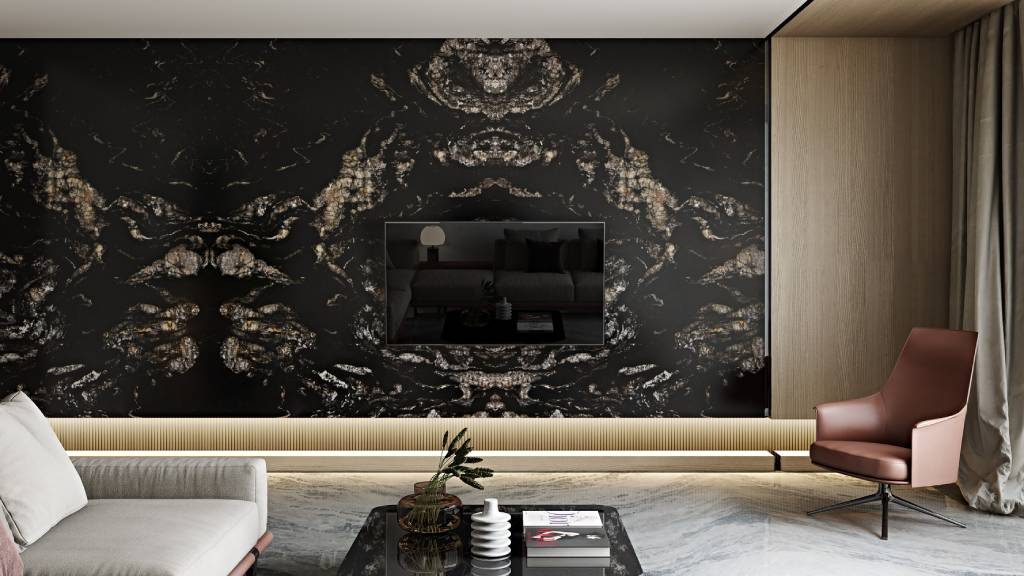
When the goal is to let statement marbles take centre stage, bookmatching amplifies their natural impact. A black book match marble composition can feel sculptural when pale or metallic veins cross a deep background. It works well in bars, formal lounges and entrance foyers, with warm lighting, dark timber or burnished brass.
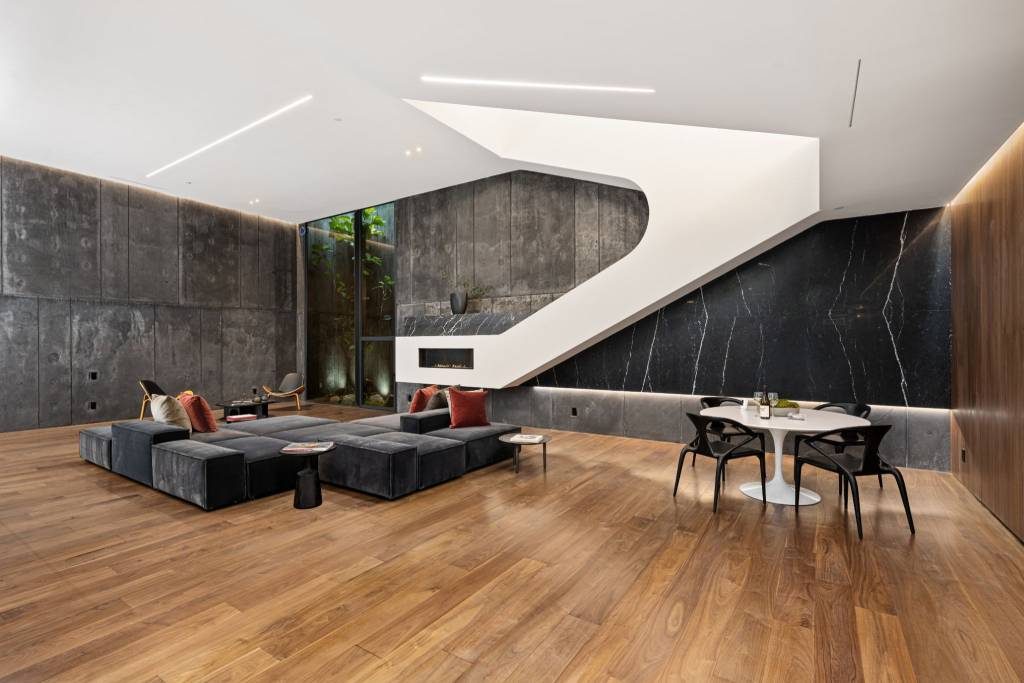
Popular Applications of Bookmatched Marble in Home Interiors
The scale of bookmatched marble suits surfaces that can be seen with minimal interruption. In Indian luxury homes, it is commonly planned for living areas, foyers, bathrooms and dining spaces, where rare and precious marbles can become a defining element alongside bespoke furniture and layered lighting.
Bookmatched Marble Feature Walls
A marble bookmatched feature wall can turn a large vertical surface into artwork. In a foyer, the central vein can align with the entrance axis; in a dining room, it can sit behind a console or table; and in a double-height space, multiple slab pairs can extend the composition upwards.
Keep switches, niches and visible service panels away from the most expressive section. A clean bookmatch marble wall benefits from restrained surrounding finishes, such as timber panelling, textured plaster or neutral upholstery, so the veining remains easy to read.
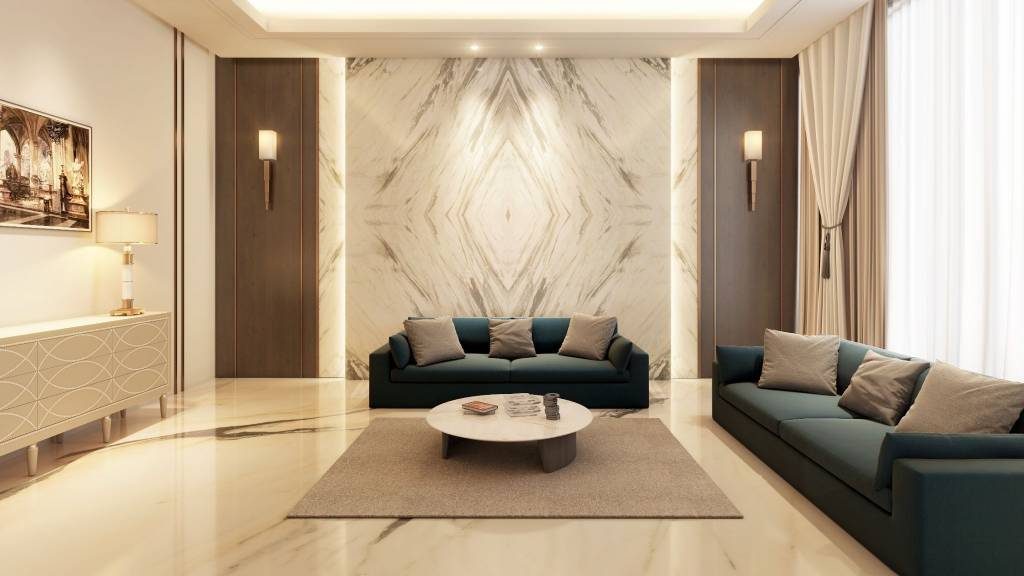
Bookmatched Marble Living Room Walls
Living rooms offer enough viewing distance to appreciate broad veining and mirrored movement. A TV wall can use the stone behind a slim screen or floating console, while a focal wall in an open-plan room can visually organise the seating and dining zones.
When exploring bookmatched marble accent wall ideas for living rooms, begin with the wall proportions and the direction of natural light. Daylight sharpens contrast, while concealed warm lighting gives darker stones greater depth in the evening. A bookmatch marble wall works best when tall furniture does not cover the centre of the pattern.
Bookmatched Marble Bathrooms
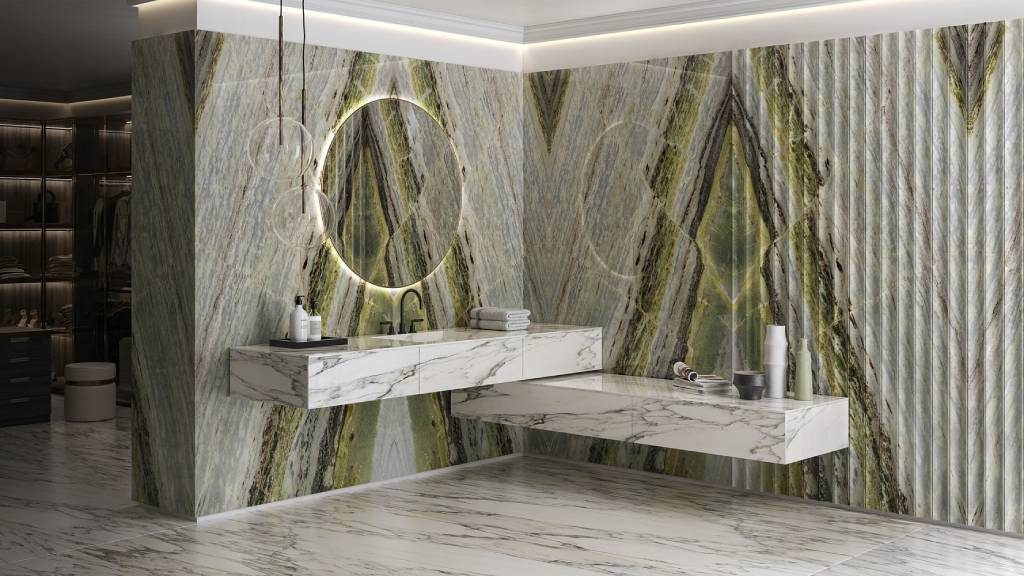
A book matched marble bathroom can use mirrored slabs across a shower wall, behind a freestanding bath or as a full-height vanity backdrop. The technique works well in larger bathrooms where fittings do not repeatedly interrupt the design.
Plan taps, mirrors and shower controls around the vein movement before fabrication. In wet areas, correct sealing, drainage and stone-compatible installation materials are essential. Softer veining creates a composed master bathroom, while bolder stone is well suited to a guest powder room.
Choosing the Right Slabs for a Bookmatched Marble Design
Good bookmatched marble slab design ideas begin at the slab-selection stage. A sample is rarely enough because the success of the composition depends on how the complete pair opens and aligns. If you are wondering how to check Italian marble quality, begin with the actual slabs rather than a small sample. For bookmatching, viewing the adjoining slabs together also helps assess their veining, colour and overall alignment.
Use this checklist while selecting book matched marble slabs:
- View both adjoining slabs together and confirm that they are sequential cuts from the same block.
- Check the central match line for continuity, colour balance and unwanted gaps.
- Study the pattern from a distance rather than judging individual veins in isolation.
- Match the scale of the veining to the wall. Broad movement suits large surfaces, while finer patterns work better in compact rooms.
- Confirm usable dimensions after accounting for trimming, joints and site measurements.
- Decide the finish in advance. Polished marble intensifies colour and reflection, while honed marble looks softer.
- Photograph and label the final slab sequence before fabrication.
Design Considerations for Bookmatched Marble Installations
Placement: Centre the mirrored seam in relation to the architecture. Aligning it with a doorway, vanity, fireplace or furniture axis creates a more resolved composition.
- Scale: Allow enough uninterrupted surface for the pattern to read clearly. Small wall sections can crop the veining at awkward points.
- Lighting: Use wall washers, concealed linear lighting or positioned ceiling spots. Avoid glare directly across highly polished stone, especially behind televisions and mirrors.
- Vein alignment: Finalise slab orientation before cutting openings for sockets, fittings or fixtures. Even a minor shift can alter the visual centre.
- Installation: Large slabs require accurate levelling, suitable support and experienced handling. Dry-laying the design first confirms the sequence before fixing.
- Care: bookmatched marble maintenance and care follows the same principles as other premium natural-stone surfaces. Use a soft cloth and pH-neutral cleaner, wipe spills promptly and avoid acidic or abrasive products. Seal the stone as recommended for its porosity and application and arrange professional polishing when the finish begins to lose clarity.
Bookmatched Marble Ideas for Contemporary Luxury Homes
Bookmatched marble creates a sense of symmetry and continuity, turning natural veining into a considered design feature. From statement walls to intimate spaces, these applications allow the stone to become an integral part of the architecture.
-
- Living room TV backdrop: Use a pale slab pair behind a slim television and floating console. The mirrored veins give the media wall structure without making it appear bulky.
-
- Double-height foyer: Extend two or more matched pairs vertically to emphasise the height of a villa entrance. Position the pendant lamp slightly forward so light falls across the stone.
-
- Master bathroom wall: Place the central seam behind a bath or vanity, keeping mirrors and fittings symmetrical for a composed layout.
-
- Kitchen or bar backsplash: bookmatched marble backsplash ideas work best where upper cabinets do not conceal the main pattern. Use the stone in a dry kitchen, display kitchen or home bar, with suitable sealing for the application.
-
- Staircase landing: A matched pair creates a clear visual pause between levels. Choose a pattern that can be seen from both the lower and upper floor.
- Dining-room backdrop: Position expressive veining behind a console or dining table, then pair it with timber, glass or brushed metal so the stone remains the principal surface.
At The Quarry, homeowners, architects and designers can view full natural-stone slabs together before finalising the layout. This is important with bookmatched marble, where the complete pair, fabrication plan and final placement need to be considered as one design decision.
FAQS
Yes. In bathrooms, it works behind vanities, baths and showers when correctly sealed and installed. In living rooms, it is commonly used for TV walls, focal walls and open-plan spaces with sufficient viewing distance.
Choose sequential slabs from the same block and view them open together. Check the vein continuity, colour consistency, usable dimensions, finish and how the central seam relates to the room’s architecture.
Yes. It is particularly well suited to feature walls because the scale and symmetry of the veining can define the surface without additional decoration. Careful slab placement and limited visual interruptions produce the strongest result.
It is created by placing two consecutive slabs from the same block beside one another in mirrored orientation. Their veins form a symmetrical pattern across the central joint.
It combines the individuality of natural stone with a visually ordered pattern. Designers value it for its scale, symmetry and ability to create a distinctive focal surface using the stone’s own veining.
Consider slab sequence, wall proportions, vein alignment, fixture placement, lighting, joint width, support and sealing. Finalise these details before fabrication so the mirrored composition remains intact during installation.
It can be used on living room walls, foyers, bathrooms, dining backdrops, bars, stair landings, kitchen backsplashes and bedroom feature walls. Larger, uninterrupted surfaces show the mirrored pattern most clearly.